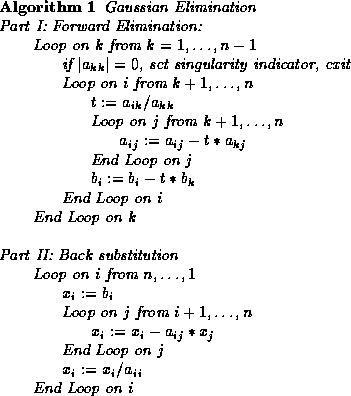
Let us turn to the general problem (1.1):
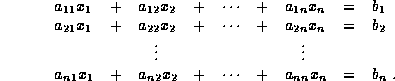
If  , we can eliminate the unknown
  from each
of the succeeding equations. A typical step is to subtract from
equation i the multiple
from each
of the succeeding equations. A typical step is to subtract from
equation i the multiple  of the first
equation. The results will be denoted with a superscript 2 . The step is
carried out by first forming
of the first
equation. The results will be denoted with a superscript 2 . The step is
carried out by first forming

and then forming

and

The multiple of the first equation is chosen to make  , that
is, to eliminate the unknown
, that
is, to eliminate the unknown  from equation i . Doing this for
each
from equation i . Doing this for
each  we arrive at the system
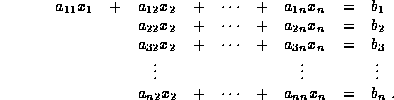
Notice that if we start out with A stored in a C or FORTRAN array, we
can save a considerable amount of storage by overwriting the
 with the
  as they are created. Also,
we can save the multipliers
as they are created. Also,
we can save the multipliers  in the space formerly occupied
by the
in the space formerly occupied
by the  entries of
A and just remember that all the elements below the diagonal in the first
column are really zero after elimination. Later we shall see why it
is useful to save the multipliers. Similarly the original vector b can
be overwritten with the
entries of
A and just remember that all the elements below the diagonal in the first
column are really zero after elimination. Later we shall see why it
is useful to save the multipliers. Similarly the original vector b can
be overwritten with the  as they are formed.
Now we set the first equation aside and eliminate  from equations
 in the same way. If
  , then for
 we first form

and then

and

This results in
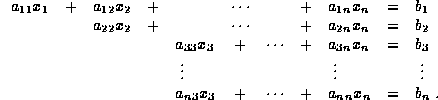
As before, we set the first two equations aside and eliminate  from
equations
from
equations  . This can be done as long as
  .
The elements
.
The elements  are called
pivot elements or simply pivots.
Clearly, the process can be continued as long as no pivot vanishes.
Assuming this to be the case, we finally arrive at
are called
pivot elements or simply pivots.
Clearly, the process can be continued as long as no pivot vanishes.
Assuming this to be the case, we finally arrive at
In the computer the elements of the original matrix A are successively
overwritten by the  as they are formed, and the
multipliers
as they are formed, and the
multipliers  are saved in the places corresponding to the
variables eliminated.
The process of reducing the system of equations (1.1) to the form
(1.11) is called (forward) elimination. The result is a
system with a kind of coefficient matrix called upper triangular.
An upper triangular matrix
are saved in the places corresponding to the
variables eliminated.
The process of reducing the system of equations (1.1) to the form
(1.11) is called (forward) elimination. The result is a
system with a kind of coefficient matrix called upper triangular.
An upper triangular matrix  is one for which

It is easy to solve a system of equations (1.11) with an upper
triangular matrix by a process known as back substitution. If
 , we solve the last equation for

Using the known value of  , we then solve equation n - 1 for
 , and so forth. A typical step is to solve equation k ,

for  using the previously computed
  :
:

The only way this process can break down (in principle) is if a pivot element is zero. The objective of this lesson is to exercise the array constructs in the language. Therefore, the other important considerations will be avoided.
The algorithm for elimination is quite compact: